“…All that I know now is partial and incomplete, but then I will know everything completely, just as God now knows me completely.” 1 Corinthians 13:12
Why should these words bring more peace, stability, encouragement, confidence, and hope to my soul than any other words I know?
Because…
I know there is nothing hidden. God sees all that I am. And so, I have nothing to try to hide. In Christ, I am free from shame and condemnation.
God loves me, despite myself. He loves me unconditionally. I am freed from the fear of abandonment and conditional love.
There is no circumstance or situation that I will face that is “outside” of God’s sight. I can fully trust that He will care for me.
There is no one I can be more honest and vulnerable with about my fears, weaknesses, and flaws than Him. I know He will NOT reject me.
Since God is aware of my needs (and my shortcomings, flaws, and weaknesses), I can be confident He will provide me with the strength and spiritual resources to face everything in front of me.
God knows my strengths. He can and will use me in ways I would have never imagined.
God knows where and when I will drift away, and I trust He will faithfully guide me back toward Him.
God knows who He created me to be, and through faith and obedience to Him, I can experience the abundant life He has for me.
For me, this is real freedom and real security. This is good news! My hope and confidence today rest in being fully known and loved by God.
Men, we can gather together. We can sit around fires and talk openly about real things in our lives. But if we don’t have real accountability, I almost wonder “what’s the point?”
From what I am learning, real accountability takes work. It requires vulnerability, honesty, humility, discipline, time, and dedication. You have to be willing to risk, give, accept feedback, change, and grow, even when it hurts.
It’s much easier to drift away from the hard work accountability requires, make excuses, or think “I can do this alone” or “I don’t need help.” In fact, there are quite a few ways to stay hidden from accountability.
I believe most guys want it (at least inwardly). I believe we need it. I’m not presenting a solution here, and I don’t have the answers. But I hope to move you to consider the impact accountability can have on your life.
To me, real accountability is honest. It faces things lovingly. It tries to restore what has been damaged. And for me, it helps identify my blind spots, my pride, my fears, and my wounds. I’ve also been learning that real accountability needs the right ingredients, the right connection and the right community.
Guys, real accountability is worth it. I really believe you will get out of it far more than you might imagine. I believe it shapes us, and it benefits our marriages, families, communities, and society.
Don’t do this alone. It won’t work. Accountability requires relationship.
Today, I encourage you to find another man who is motivated to live accountably, and commit to put in the work with him.
Take that step.
My Journey
I’m not an “expert” in men’s matters. In fact, I have learned some of the most important lessons about being a man through my own failures and missteps. I’ve also learned from the experiences of other men.
Yet, when it comes to men and accountability, I may be a seasoned expert in not doing it well. For many years, I learned the ins and outs of avoiding the difficulty of real, intentional, challenging friendships and accountability.
But lately, I’ve entered a new season of life where finding community with a few other men who will encourage me, challenge me, call me out when I drift, and confront my sin has become critically important.
While there is much more that could be said, I hope to share a few important things I’ve learned that may help you in your own journey. Here, I want to explore barriers to accountability, and what real accountability takes.
Where I May Drift
I’ve noticed in my own life that my natural drift is not toward accountability.
Real accountability is hard. It’s often painful. It requires vulnerability, honesty, time, humility, and relationship. It’s much easier to drift away from the real work accountability requires.
Here are some of the places drift may happen:
Lack of Clarity: Who are you accountable to?
Avoidance: “It’s not my business”, “I’ll do it later.”
Passivity or Fear: “I know I need this, but I don’t feel comfortable asking someone.”
Lone Wolf Mentality: “I can do this alone.” “I don’t need help.”
Loss of Community: Through divorce, isolation, or life circumstances
Past Hurt: maybe accountability went wrong, or wasn’t done well.
Unwillingness: To truly share or confess.
Shadowed Truth: Sharing part of the truth, but not the full depth.
Bouncing: From group to group, friendship to friendship, or “accountability partner” to “accountability partner”.
Running: When accountability becomes uncomfortable or painful.
Lack of Follow Through: Not meeting regularly or implementing what is actually needed.
How It Becomes Real: Accountability Requires (At Least) Two
Accountability is mutual work between men to help each other stay on the right path.
It encourages, warns, corrects, strengthens, and brings hidden things into the light. Real accountability speaks honestly, faces things lovingly, and helps (or tries to) mend what has been damaged in the relationship.
It is a mutual responsibility to sharpen, refine, protect, and influence another man’s life in a positive way. It requires attentiveness, watchfulness, and actual care, not only for your own life, but for another’s.
Of note, perhaps one major breakdown in accountability happens when two men are not truly aligned. I have observed that it takes at least two committed men, both intentionally seeking to hold each other accountable– gently, humbly, and lovingly– for real accountability to thrive.
How It Becomes Real: Accountability Requires Investment
Accountability looks like a lot of things: meeting together, speaking truth, listening well, confessing openly, praying, encouraging, correcting, warning, hoping, and loving one another consistently. The first one definitely requires a time investment. Many of the others require an emotional investment.
You may not have the right foundation for accountability investment if the things below are showing up, or, you may need to work through them together and try to find a solution.
Over-Busyness: “I just don’t have the time.”
Passivity: Too afraid to speak truth, challenge, correct, or admonish
Poor Follow Through: Saying you’re committed but not consistently showing up
Lack of Care: Your choices, struggles, or mistakes don’t really matter to the other person
It takes time, effort, and work, but let me tell you the investment is worth it. I know the ways I have been shaped through challenging conversations, and how truth brought to me lovingly has mattered more than almost anything else I can think of in my friendships.
How It Becomes Real: Accountability Requires the Right Soil
You have to truly get to know one another. Without the soil of an actual relationship, it becomes difficult to really know what is happening beneath the surface and for fruit to be produced from the investment.
Here are a few key “soil” elements to consider:
Consideration: Do they genuinely care?
Safety: A relationship and space where both men feel safe enough to open up honestly
Willingness and Desire: A true motivation to live openly and be accountable
Right Partnership: Cooperation with the right motivation, perspective, and availability
Honesty and Transparency: Saying it how it really is, unafraid to speak truth lovingly
Vulnerability: A willingness to enter the deep and difficult places
Discipline: Consistently meeting, sharing, confessing, and talking
Submission: The humility to truly listen, learn, and change course
Long-Term Perspective: Continuing even when life feels “fine” and things are “status quo”
Soil matters.
Accountability First Happens Vertically
Who are you accountable to, and why?
I’ll keep this short: I believe a man must first hold himself accountable to God before anyone else. Otherwise, accountability breaks down.
Real accountability is vertical first.
Accountability Thrives Horizontally
Growing horizontal relationships are integral to thriving accountability.
When I think about the need for men to be in a community that truly loves them and walks alongside them, accountability becomes inseparable from brotherhood. I also believe friendship and accountability are intertwined; they work best together.
I’ve found that regularly meeting with other men, building real friendships, being part of a men’s group, and staying as consistent as possible creates space for accountability to naturally grow. Finding spaces, like around fire pits, meals, coffee, and phone calls, has been helpful. Honestly, just spending time getting to know other guys and allowing them to get to know me has been the best. I’m not perfect at this, but I’m excited about where things are heading.
In Conclusion
My key accountability point here is: don’t do this alone. It won’t work.
Accountability ultimately requires bold truth, gentle love, humility, consistency, and a willingness to truly share life with other men. Men have to show up.
The benefits to us are tremendous. Deeper friendships can grow. Wisdom can be found. Better choices can be made. Encouragement can be given and received. And we can be strengthened inwardly.
I truly believe that real accountability refines men and benefits marriages, families, communities, and society. We need it. Let’s find spaces and ways to allow it to grow and thrive!
Moving Forward
If you feel far from real accountability, or not where you want to be, you’re not alone. Please don’t be discouraged.
Consider where and how you can take action today, and where you can begin plugging into a community and friendships. Find a men’ s group close to you and get started.
For you,
→ How do you define accountability?
→ Who are you accountable to?
→ How would you want it to look different in your life?
I would love to have your feedback on all of this.
“I am blameless before God; I have kept myself from sin.” –David, Psalms 18:23
I’ve wondered what this word really means and what David meant in what he said. David, blameless? He screwed up big time. I figured this word had to mean more than what I thought. If it means flawless perfection or sinlessness, who could ever say this? Only Jesus, or a liar.
Here is what I learned*…
In the OT, the Hebrew word for blameless is “Tamim”.
In terms of character, it can mean integrity, sincerity, moral completeness, wholeheartedness. In terms of faith, it can mean sincere faith, not living in hypocrisy. In other words, to me, it means an honest and pure faith.
When David uses this, “he is speaking of integrity towards God, covenant faithfulness, and not living in rebellion against God’s authority.” David’s noted pattern is to repent when he sins, and not harden himself against God.
In the NT, the words used in Greek: “Amemptos”
Means: without blame, above reproach, not open to accusation, no obvious moral inconsistency
“Anegkletos”
In leadership, no legitimate accusation sticks, not chargeable
Summary
Biblical blamelessness looks like:
Wholehearted toward God Aligned with Him (public + private life) Repentant Consistent over time WIthout hidden rebellion
“It means less about never failing, and more about how a man lives, reacts, responds, repents, and walks. Overall, a life of integrity that holds together under observation”
“He does not live a life characterized by hypocrisy, hidden rebellion against God, and/or persistent refusal to respond to truth.”
*ChatGPT used to assist research
As I see it, perhaps this description of Job is the simplest way to describe blameless:
“There once was a man named Job who lived in the land of Uz. He was blameless—a man of complete integrity. He feared God and stayed away from evil.” Job 1:1
From a salvation standpoint, believers of Jesus Christ stand blameless before the greatest accuser, Satan, because of the blood of Jesus.
We are called to live blameless lives, to present ourselves as living sacrifices, to be set apart for the Lord.
These verses are a great encouragement to any of us struggling with shame, doubt, or fear today:
“Now may the God of peace make you holy in every way, and may your whole spirit and soul and body be kept blameless until our Lord Jesus Christ comes again. God will make this happen, for he who calls you is faithful.“ 1 Thessalonians 5:23-24
My Personal Take Away
Personally, what struck me in all of this regarding blamelessness is how I thought of it as perfection, which is simply unattainable.
Also, the concept of being whole or divided. I lived a divided life, described here:
“Integrity can be defined as “the state of being whole and undivided”–and I was a divided man. Internally, the fracturing of truthfulness in my life led to personal unsettledness, inner turmoil, heaviness, and a discontented soul. This pulled me further inward and away from others–even though I wanted to be close to them. This also brought inward shame that caused me to pull away from God…I hope my story leaves an impression in your mind, especially if you are looking to move forward in personal integrity. Please understand how much the little things matter. White lies, half-truths, fudging the facts, omitting the details—these feel easy in the moment and less noticeable the smaller they are. But over time, these “pebbles” sink ships. In contrast, showing up with personal integrity and truth, in the small things, over and over again, builds character and trustworthiness, and moves a man towards wholeness.”
If you would like to learn more about my story, read more here:
I know the influence a mother has on the lives of men– I see and hear of it often from other men, and I know of it from my own story. Our mothers shape parts of who we are, and who we are becoming. The evidence is strong:
“A mother serves as a significant role model, demonstrating behaviors, values, and life skills that a son can emulate. She can inspire her son to dream big, pursue his goals, and develop a strong sense of self-worth. A man’s relationship with his mother can influence his understanding of relationships with women and his ability to form healthy and fulfilling partnerships. Even as a man matures and establishes his own family, the influence of his mother is lifelong and can continue to shape his values, behaviors, and relationships.”
I believe a son becomes a man who understands women, relationships, life, faith, and even God, in large part, through the lens of how he sees and what he has observed in his own mother. Even if the time is short, her influence on his life is great.
Her Faithfulness
From my perspective, the greatest impact a mother leaves on her son’s life is her faithfulness.
I’ve observed my own mother’s faithfulness over decades. As a child, I remember seeing her on her knees praying, regularly. I knew her faithfulness, not only to God, but towards me, personally. I experienced how she served me and my entire family, in love, day in and day out. I observed (and still do) her faithfulness towards others, serving and helping so many people along her way.
My mother’s footprints are big, because they are filled with the lives of those she has served and been generous in love towards.
They are imprinted on my heart, because of her faithfulness.
Thank you, mom!
Moving Forward
Mothers, you are powerfully influencing the next generation of men. You are raising sons who can become healthy, confident, secure, loving, and serving men, by your faithful example. Mothers, YOU are essential!
This question often seems to baffle me, especially in the midst of life’s circumstances. I often feel lost looking for God’s will in the decisions I make and the circumstances I face. I wonder how many times I muddy up God’s will, when it is actually quite clear?
1 Thessalonians 5 paints a practical and clear picture of God’s will for my life:
Warn the lazy (undisciplined, idle)
Encourage the timid (fearful, discouraged)
Tenderly care for the weak
Be patient with everyone
Do not pay back evil for evil
Always try to do good
Always be joyful
Never stop praying
Be thankful in all things
Also…
Test everything that is said
Hold onto what is good
Stay away from every kind of evil
I have a personal relationship with Jesus Christ; within this, much of God’s will for my life is actually clear. From what I understand in 1 Thessalonians, it is to become holy and blameless.
Now may the God of Peace make you holy in every way, and may your whole spirit and soul and body be kept blameless until our Lord Jesus Christ comes again. 1 Thess 5:23
Thank God that this is not dependent on my efforts! I can’t count the number of times I fall short. My personal responsibility is engulfed here with God’s faithful active working in the transformation of my mind, body, soul and spirit. He won’t leave me unfinished.
God will make this happen, for he who calls you is faithful.” 1 Thess 5:24
If you are wondering what God’s will is for you now in your circumstances, jump into first Thessalonians chapter 5 and explore for yourself. It starts with knowing God and a relationship with him. And know this– God is faithful! He will not quit.
I once met a man going through a divorce, who told me a story I am not going to forget.
He was angry at his ex for something that she did, so he went to her home and poured boxes of nails behind the tires of her car. In addition to contempt charges, he was now facing a felony charge because the damages to her car were greater than $2,000– she had very nice tires on her Tesla! I had to wonder what the judge thought when the case was brought in. Stupid.
This example may be extreme, but I found myself wondering if there was sensible advice to be shared with dads going through divorce— simply put, “don’t do this stuff”.
Recently, I had a conversation with a retired family court judge with years of experience in divorce and family law cases. I want to share some of the key perspectives she shared with me. I encourage you to keep reading, especially if you have children and desire to walk through your situation well, for their sake.
5 Things Judges Hate: Perspective From a Retired Family Court Judge
1.Subjecting the children to your conflict:
What I Learned: Whatever you are going through and whatever the issues are, don’t bring your kids in or put them in the middle of the conflict you have with your ex. Protect them from this.
2.Badmouthing the other parent:
What I Learned: This is a no-go. Always speak respectfully about the other parent in front of the children. And, I might add: do this across the board, anywhere, no matter who you are with. Your negative words may come back to haunt you, not only in court, but down the line in your relationship with your children and the other parent.
3.Attempting to micromanage the other parent’s parenting time:
What I Learned: Don’t overreach. Don’t schedule events on the other parent’s time, or attempt to manipulate and micromanage what they are doing with the kids during their custodial time.
4.Failing to notify the other parent of major life events:
What I Learned: Major medical changes, awards, school events or events of significance to the children? Don’t leave the other parent out– communicate! This will help your kids and your co-parent.
5.Being Hypocritical:
What I Learned: Mean what you say, and be prepared to live by what you fight for. If you fight for 50% custody in court, you had better be there, present, for your kids during your time. Be ready to hold up to and live out what you agreed to and fought for as best you can.
Moving Forward
You will be evaluated. Not just by words on paper, but by how you show up and have been showing up. If you have been or are lying, hiding, manipulating, being deceitful or vindictive, it may very well catch up with you when you are observed in the courtroom. So just be honest and do what is right, all the time.
Next week, I’ll share more judge-reviewed content on this topic. I hope this helps.
I’m going to jump straight in: divorce can reveal how selfish, self-centered, and prideful we men can be. It can bring out the worst in us.
So why not look towards and pursue the best?
Here, I want to appeal to all of you men going through divorce to look at the best in 3 ways.
An Appeal To Civil Behavior and Respect
Don’t overthink this. When it comes to your ex, or anyone else, as you are moving through your divorce…
Be honest.
Do good
Don’t take revenge
Be honorable
Don’t think you know it all
Don’t be a hypocrite
Pursue peace
Love others
Seek justice
Work hard
Help others
Practice hospitality
Be kind
An Appeal To a Higher Standard
Don’t stop there. Go above and beyond…
Help your ex (where you actually can)
Desire good for her and bless her
Really love her, and others, even if they abandoned you
Use your gifts to help others
Be merciful
AnAppeal To Be Transformed
This is not just about you. This is really about you and God.
Real change, truly transformed living, in the heat of divorce and beyond, is only by and through God. We men need our thoughts and mindset to be completely overhauled by Him for this to move beyond “divorce behavioral modification strategies” and become the real way we live. We need to be right with Him first.
Let’s consider what God has done:
Oh, how great are God’s riches and wisdom and knowledge! How impossible it is for us to understand his decisions and his ways! For who can know the Lord’s thoughts? Who knows enough to give him advice? And who has given him so much that he needs to pay it back? For everything comes from him and exists by his power and is intended for his glory. All glory to him forever! Amen. Romans 11:33-36
Let’s allow Him to begin changing and shaping our minds:
Don’t copy the behavior and customs of this world, but let God transform you into a new person by changing the way you think. Then you will learn to know God’s will for you, which is good and pleasing and perfect. Romans 12:2
Let everything–all we are and all we have–be for Him!
And so, dear brothers and sisters, I plead with you to give your bodies to God because of all he has done for you. Let them be a living and holy sacrifice—the kind he will find acceptable. This is truly the way to worship him. Romans 12:1
And finally, because God has extended forgiveness and mercy to everyone, men–let’s forgive and be merciful.
Real change, in our minds is the only thing that will bring us through divorce and towards living beyond it well.
To Consider When Moving Forward: What Are Our Barriers?
I’ve identified several internal barriers that may keep us from changing, thinking rightly, and engaging well with others, especially our exes, during and after our divorces:
Emotional turmoil – reactively living
Pain and wounding – hurting back
Anger and rage – explosive power or simmering/stewing
Pride and stubbornness – refusal to be kind or cooperate
Bitterness and contempt – hating her or others
A lack of peace within us
A lack of gratitude for what we have; an “I deserve this” mentality
A lack of humility
A lack of understanding of God’s mercy towards us—His love
I hope you will honestly evaluate yourself, your thoughts, and your patterns of behavior today, and ask what is really shaping you.
These are places men often realize we need something beyond ourselves to help us—to help ease pain, comfort us, encourage us, heal our wounds, rebuild our lives, etc.
These are places we really become needy.
On the surface, a needy man sounds weak and pitiful. But there is a “neediness” that is good, and I believe a man who is truly needy, and realizes it, is in a far better place—circumstances aside—than a needless man.
Defining Neediness
Blessed—truly happy—are the poor in spirit—spiritually needy men who see their need for a God who can rescue them and place their feet on solid ground.
Our God-neediness is often found in the hardest places, in the most desperate circumstances. Take, for example, divorce—a time when men seem to be most likely to reach out to other men for support.
Who we turn to, and where we turn, matters. Look where David turned:
But as for me, I am poor and needy; please hurry to my aid, O God. You are my helper and my savior; O Lord, do not delay. Psalms 70:5
Neediness and Humility
Our neediness is linked to our humility, and there are various shades of humility we are moving through as men. Life and circumstances seem to have a knack for revealing this.
But humility—a real humbling—is the starting point for the greatest work in our lives to begin; the start of our movement toward the real purpose God has for our lives.
Because our neediness is discovered in humility—our eyes only begin to see in that heart condition. To see what we truly need, ask God for His help, and look to see Him working.
We must be humble to see God at work. And real gladness comes from seeing God at work. Humility is our starting point.
What does it take to humble us? I think it is different for every man to reach that needy and “ready” spot of humility, where we recognize our need for God’s help. Sadly, not all men arrive here.
I would much rather be a needy man, than a man who thinks he needs nothing.
Where Are You Today?
No matter how bleak your situation appears, if your heart is ready to receive God’s help and love—you may be in a much better place than you may realize. Remember, for this is true,
The humble will see their God at work and be glad. Let all who seek God’s help be encouraged. For the Lord hears the cries of the needy; he does not despise his imprisoned people. Psalm 69:32–33
Turn to Him today.
Alex Gerber gerberxc@gmail.com
Photo: I took the photo above in the height of my neediness, the hardest part of my life in 2023. I was reminded each day of God’s goodness towards me through the morning sunrises.
How absurd does the title sound? Really—who would think about picking out a nice, comfortable spot to settle in when there is a war raging all around?
Yet—I do it regularly.
I look for comfort and ease. I drift toward what feels right. I forget to fight for what matters, or worse yet—I become apathetic, lazy, and cozy.
Open my eyes up! This is not good. If I don’t fight this drift, darkness and decay, I will be dead by sundown.
And yet near me—within reach—is everything I need to be victorious.
God’s truth. Christ’s righteousness. The Good News of the Gospel. Salvation and Faith. His Word. Peace. And the Holy Spirit.
God—open my eyes to see what matters to you. Wake me up to the battle around me—don’t let me sleep!
When the smoke clears, Jesus, I want to see you clearly.
You are my only hope.
Alex Gerber April 25, 2026
Photo note: I took this photo overlooking a field in Virginia near a location where Civil War fighting occurred, and this picture highlights an eerie morning mist rising from the field
I wanted to explore ways that a home health organization can look far beyond just providing patient care, and look at opportunities to leave a lasting impact on lives and communities. If you are a healthcare provider or leader, I hope that my curiosity here will encourage and inspire you to think of ways to maximize the impact you have in healthcare, and ensure that every person touched by your care feels that they are seen, known, and loved. I want to see healthcare given in a way that says “you matter, and I care.”
Connecting To Community
A home health care organization is part of more than just one community. You have a community of clinicians that comprise the organization. You also have the community of patients and families that these clinicians serve. And around these is the greater scope of the community in which both clinicians and patients live and work. All of these communities are intertwined; and I believe where one succeeds, the other prospers.
For example, a stronger internal organizational community strengthens the delivery of patient care to the external community. And a stronger external community strengthens the ability of the clinicians’ care to be effectively implemented.
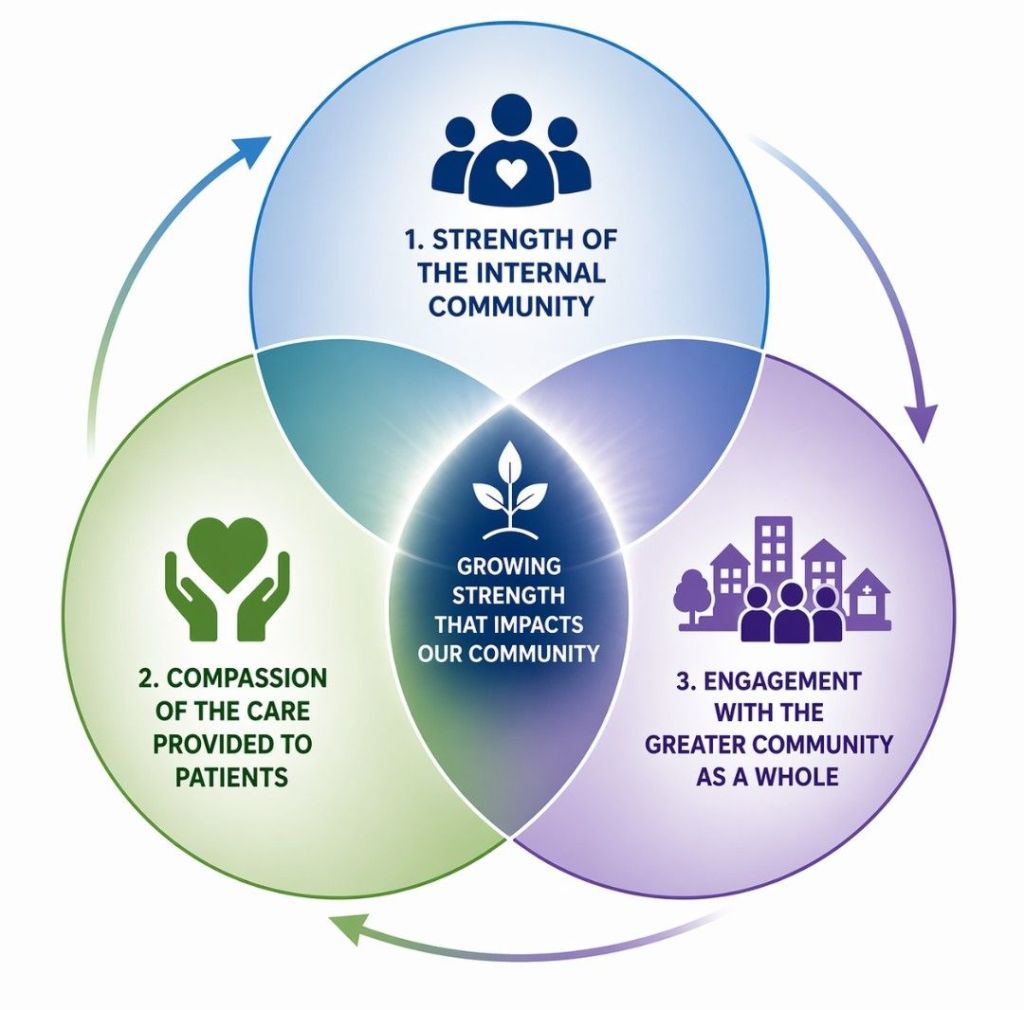
To simplify, I want to visualize this in three working areas I see that comprise flourishing home healthcare provision:
Strength of the internal community.
Compassion of the care provided to patients
Engagement with the greater community as a whole.
I see these as three overlapping circles, or areas of influence. The greater the overlap and flow between these three areas, the greater the strength of the growing force that impacts the community as a whole.
From Inward To Outward
Home health organizations that strive to strengthen bonds and relationships within their ranks can powerfully impact patient care by bringing stronger and more understanding clinicians to the doorsteps in communities they serve.
They can engage with and enhance the greater community as a whole, through targeted outreach and strategies to unite their resources, services, and mission with community nonprofits and groups.
An organization that finds ways to work with all of these together can better meet the needs of the clinicians, the patients, and the community as a whole.
What Elements Move An Organization To Truly Thrive?
I see the necessity of these elements in an organization that wants to move beyond successful, to truly thriving, and bringing enrichment to communities.
The organization should…
Build – encourage, sharpen, and strengthen, both internally and externally (clinicians and patients)
Mentor – show and demonstrate compassionate care in action, the “how-to”.
Fellowship – meet regularly (home health can be isolating), and enjoy the company of colleagues you are working with.
Serve – give beyond your home health position or branch – look at group service opportunities to give to the community.
Engage – with the patients and community (beyond just medical).
Grow in presence – by how they care; word of mouth, reputation, and relational investments.
Lead in love – find and develop leadership motivated by compassion, care, and love, that serves as an example.
An organization that can cultivate growth in these areas can be better positioned to exemplify a compassionate care model that can truly change individuals and communities.
My Take
The greatest healthcare organizations build strong clinicians to bring better care for their patients for a stronger community, without neglecting the unique, individual relationships that comprise this entire community.
They are moved to give through love, lifting spirits and refreshing hearts through kindness.
Alex Gerber Doctor of Physical Therapy Charleston, SC gerberxc@gmail.com










 Moving Forward